
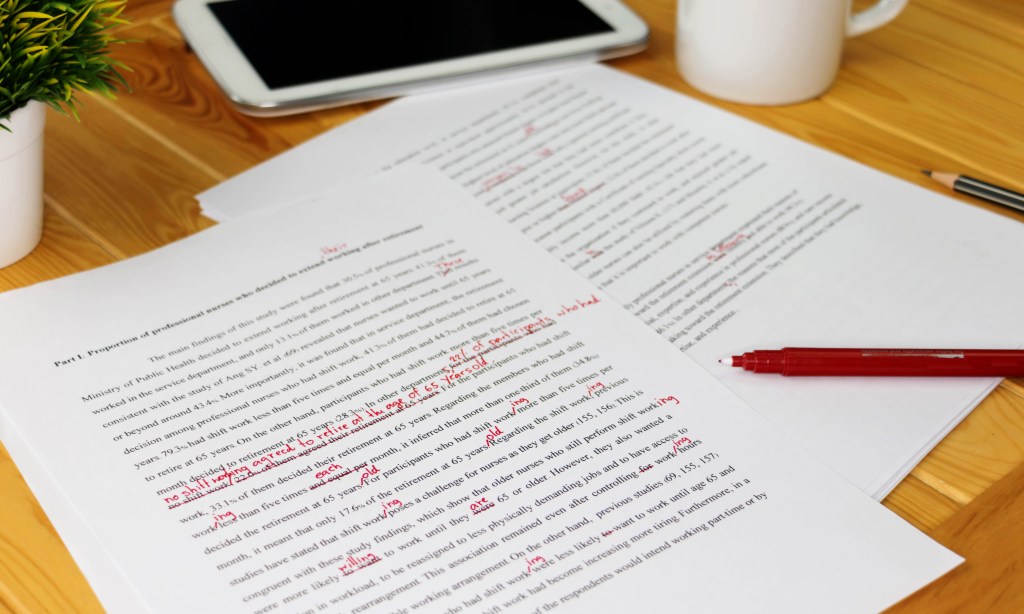
When you finish writing a book, you may feel a rush of emotions – pride, relief, satisfaction. But you might also feel a sense of “What now?”. You’ve been working on this manuscript for so long; what do you do now that it’s done?
The answer, of course, is editing! There are several stages of editing your book will need to go through before it’s ready to hit bookshelves. Below, we’ll dive into the five types of editing and why each one is important for your book.
- Why Is Editing Important?
- Developmental Editing
- Content Editing
- Line Editing
- Copy Editing
- Proofreading
- Specialized Editing Styles
- Get Full Editing Services
Why Is Editing Important?
Before we dive into the different types of editing, let’s talk some about why it’s important.
When you’re writing your book, you have to fall in love with it; you come to believe that your writing is amazing and inspiring, because without that feeling, you don’t get through the grueling process of writing the whole book.
But once the book is done, it’s time to take off the rose-colored glasses and take a hard look at your book for what it really is – a rough draft.
Your book may absolutely have amazing pieces in it. Some of your prose might sing, and you may have amazing twists that surprise and delight your readers.
But all those wonderful pieces are going to be surrounded by writing that may not be doing its best work in the piece. That’s where editing comes in.
The editing process chips away the awkward transitions, confusing plot holes, and other sections that are holding your book back from being something polished and amazing. It forces you to step back and view your book the way the rest of the world will so you can improve it and really give your writing a chance to shine.
Developmental Editing
Developmental editing, also called substantive editing, is the broadest, biggest-picture form of editing and sometimes happens even before the book is written.
This type of editing looks at the large-scale structure of the book – the world, the characters, the major plot points. A good developmental editor can help you make sure your story is engaging, catch potential plot holes, and keep characters interesting and relatable.
Because this type of editing deals with such massive changes, it can make sense to do it before you spend time building out the content of your book.
Content Editing
Unlike developmental editing, content editing happens after the book is written. But it does deal more with the substance of your book than the individual wording.
Content editing looks at your book on the chapter and paragraph level. A content editor will look at the flow of your book, making sure that all the transitions make sense and your characters stay consistent. They may also make suggestions to trim any scenes from your book that aren’t contributing anything or are slowing down the story.
And, if you haven’t already worked with a developmental editor, content editing can sometimes overlap with that work. This is often the first major edit that your book goes through after it’s finished.
Line Editing
By the time your book has gone through developmental and content editing, its structure should be pretty close to its final form. Then it will be time to focus in on the details.
As the name suggests, line editing begins to look at your work on a line-by-line basis. A line editor will be focused on making sure each sentence in your book sings. They’ll help you polish your prose to a mirror shine and remove any unnecessary phrasing or sentences.
It’s important to find a line editor who you can work well with, because this level of editing delves into the areas that define your voice as a writer. A good editor should help to clarify that voice, removing any distractions, without removing what makes your writing unique in favor of their own style.
Copy Editing
Copy editing is the last stage of editing before your book goes into layout and shouldn’t be done until all the wording is finalized.
A copy editor combs through your manuscript letter by letter, marking grammatical and spelling errors in the copy. They’ll fix punctuation mistakes, typos, comma splices, poor sentence structure, and so on.
Copy editing makes sure your writing is clear, easy to understand, and professional. If you’re writing a nonfiction book, having proper grammar is critical for maintaining professional credibility. And even if you’re writing a fiction book, it can be distracting for readers to have to comb through comma splices and misplaced modifiers.
Proofreading
All the editing we’ve talked about up to this point can (and often should) happen before your book ever gets submitted to a publisher. Having a clean manuscript can improve your chances of landing a contract, especially with the Big 5.
Once you sign a contract with a publisher, they may send your manuscript through another few rounds of editing, depending on your particular situation. Then they’ll send the book on to a designer who will do the interior layout design.
During this stage, your designer will choose the font for your book, set up the first page of each chapter, and add things like the title and copyright pages. They’ll take your manuscript from word processor document to beautiful book.
Proofreading happens after the layout stage is complete and is the final round of editing that your manuscript will undergo. A proofreader looks at the final layout proof and makes sure that everything is in the right place. They check for skipped or repeated page numbers, odd line or page breaks, table of contents accuracy, index accuracy, and so on.
A proofreader is the last line of defense against errors in your finished book.
Specialized Editing Styles
The five editing stages we’ve discussed so far are standard, and every book should go through them before it hits the shelves. But there are also some more specialized types of editing that you may or may not need, depending on your particular manuscript.
Sensitivity Editing
Sensitivity editing looks at any potentially controversial or delicate material in your book and makes sure it’s well-handled.
Let’s say your book deals with racial topics, LGBTQ+ issues, or mental health subjects. Appropriate language standards in these spaces are constantly in flux, and it can be easy to inadvertently cause harm with your writing, especially if you don’t belong to the group you’re writing about.
A sensitivity reader is well-versed in the latest accepted language in these spaces. They’ll go through your book and make sure it’s sensitive to those viewpoints and doesn’t include offensive language or ideas. This work can include anything from correcting pronouns to shifting how you talk about a mental illness.
Fact Checking
As you might guess, fact-checking is a research-based process that makes sure your book doesn’t include any false information. This process primarily applies to non-fiction books, especially academic works.
A fact-checker will go through your book and make sure everything you’ve written is as accurate as possible. This can include checking references, confirming statistics, researching claims, and even making sure names are spelled correctly.
Get Full Editing Services
Editing a book is a multi-stage process that looks at your book on every scale, from major plot movements to individual punctuation marks. You may not always need to hire an professional editor for each stage, but it’s a good idea to include all five in your revision process.
If you do need professional editing services, Quickbeam Literary Consulting can help. I offer full editing services, from initial developmental editing all the way down to manuscript proofreading. Reach out today and start working with an editor dedicated to helping your book be the best it can be!
 Quickbeam Literary Consulting